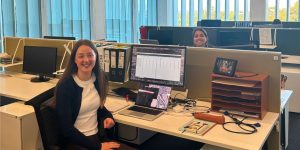
2025 OCFNZ Travel Grant recipient Rosa Latton shares her experience of visiting Dr Robb Hollis’ lab at the University of Edinburgh.
Can you tell us a little bit about your field of study?
My field of study is cancer genetics, specifically focusing on low-grade serous ovarian carcinoma (LGSOC), which is a rare form of ovarian cancer. Because it is so uncommon, LGSOC hasn’t received as much research as other ovarian cancers, which really limits our ability to find new treatments and make informed decisions for patients.
Working with Dr Robb Hollis, we began a new project investigating the expression of microRNAs in LGSOC cell lines, as well as high-grade serous ovarian carcinoma and normal fallopian tube and ovarian cell lines. MicroRNAs are important regulators of gene expression that can interfere with target messenger RNAs, preventing their translation to proteins. In cancers, microRNAs that oppose tumour growth are often reduced or lost whereas microRNAs that support tumour development can be highly expressed, which can tell us a lot about the biological changes that underlie a cancer. MicroRNA expression research is very limited in LGSOC, and to our knowledge, this project was the first comprehensive profiling of miRNA expression across a broad panel of LGSOC cell lines.
What made you choose to work with Robb Hollis and his team?
At the beginning of my PhD, I came across one of Robb’s publications on LGSOC during my literature review and was impressed by the breadth of his research. As I explored his work in more detail while preparing my grant application, I was really drawn to the broad range of expertise he has in the field, especially in bioinformatics, which is one of my main research interests. Bioinformatic analysis of expression data is the use of computer-based data analysis to help researchers understand which genes or RNAs are turned on/off in cells, which helps us understand the biological changes that contribute to a disease. I knew that working with Robb and his team would be a fantastic opportunity to develop my skills while contributing to important LGSOC research.
What did you learn while you were there?
In Edinburgh, I learned a great deal about the bioinformatic analysis of expression data, which requires a completely different approach compared to the data types I’ve previously worked with. Furthermore, microRNA work is its own niche within expression data and uses specific tools for analysis and interpretation. With guidance from Dr Hollis, who is experienced in both expression and miRNA data specifically, I learned how to apply several relevant R-based software packages, picked up new statistical analysis techniques including hierarchical clustering, and substantially improved my ability to manage and visualise complex biological datasets using R.
What did a typical day look like?
As my project was computer-based, I spent only a little time in the lab getting to know the microRNA extraction process for sequencing. In a typical day, I’d start by setting up at my desk and having a chat with Robb to discuss what I’d been working on and what to tackle for the day ahead. This was often followed by a coffee and catch up with some of the wider ovarian cancer team, then settling down for some deeper work on my tasks. As I was learning to use new software, there was a lot of reading, trial and error, and consulting with Robb as I built my confidence with the new tools. I also joined the Hollis lab and ovarian team meetings each week to hear about everyone else’s research, which was fascinating and super inspiring.
What was the highlight of your research trip?
If I had to choose just one, the greatest highlight was the new connections I made with Robb and the researchers at the Institute of Genetics and Cancer. It was an incredible experience to join a team of such motivated and talented researchers tackling ovarian cancer through a number of different lenses. Now that I’m back in New Zealand I’m very grateful to be continuing the microRNA project with Robb, and he has recently joined my PhD supervisory committee where his LGSOC and bioinformatics expertise will be extremely valuable to my doctoral research. I’m really looking forward to continuing to work together!
What are your hopes for the future of ovarian cancer research?
My hope is that ongoing ovarian cancer research will allow us to reliably detect the disease at earlier stages and treat it more effectively, ultimately leading to a future where fewer lives are lost to this cancer. Within New Zealand, I would love to see our community of ovarian cancer researchers continue to grow and work together to contribute to global research and improve our understanding of ovarian cancer in our own country, particularly in Māori patients. We need research at all levels in Aotearoa, from investigations of biological changes that drive ovarian cancer, to epidemiological studies of our local populations, and clinical trials to provide options for patients and their whānau.
What would you like to say to the supporters of OCFNZ who made your grant possible?
Because of your generosity and the dedication of OCFNZ, LGSOC patients are finally beginning to get the research attention they deserve, and I feel very privileged to be able to contribute. Beyond funding individual projects, your support builds momentum and fosters collaborations between researchers all over the world, making opportunities like my visit to Dr Hollis’s lab possible.
Here in Aotearoa we now have a growing community of researchers focused on LGSOC, a foundation that will be essential for improving our understanding of this cancer, developing new treatments, and ultimately improving outcomes for patients. Thank you for believing in and investing in ovarian cancer research! Your support makes a real difference for patients and whānau, both those navigating their health journeys right now and those who will face ovarian cancer in the future.