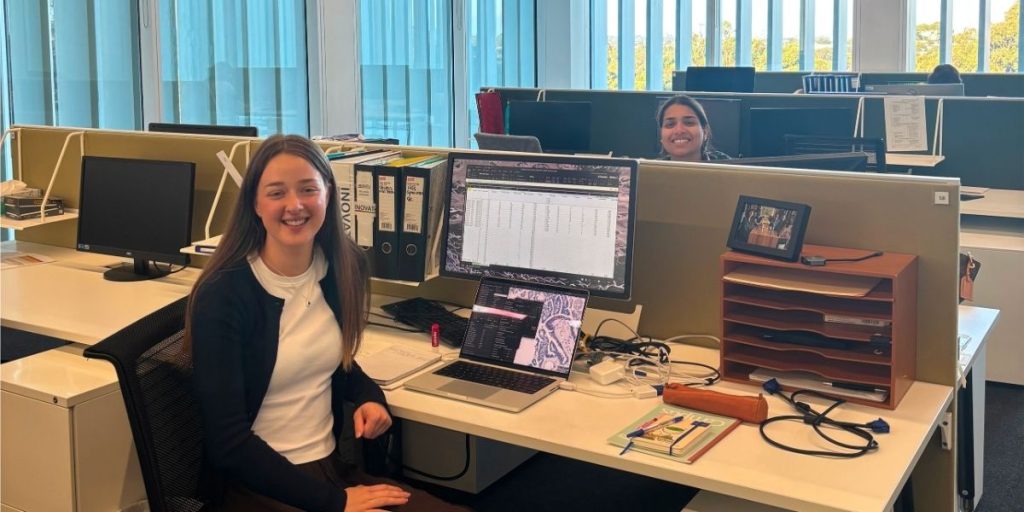
Meet Katie Walker of the University of Otago, one of the 2025 recipients of the OCFNZ Travel Grant. Katie recently traveled to Australia to work with world-renowned ovarian cancer researcher, Dr Anna DeFazio at the Westmead Institute for Medical Research.
Can you tell us a little bit about your field of study?
I am a PhD candidate based at the University of Otago in the Department of Anatomy, where I am supervised by Dr Megan Wilson and co-supervised by Dr Mike Pankhurst. Our lab group recently researched the role of a gene important for development, called LHX9. Some data suggests that LHX9 may also have a role in epithelial ovarian cancer. This naturally led to my PhD research project, which focuses on uncovering more about the role of LHX9 in epithelial ovarian cancer and will help to unveil how genes important for development influence epithelial ovarian cancer risk and development.
What made you choose to work with Anna DeFazio at The Westmead Institute for Medical Research?
I am passionate about developing my skills as a researcher and learning how research is made translational for people with ovarian cancer. This grant was a fantastic opportunity for me to expand on these skills, and led me to the decision to visit The Westmead Institute for Medical Research in Sydney and work with Professor Anna DeFazio in the Gynaecological Oncology Research Group. I am very inspired by the projects developed by Anna DeFazio, which have resulted in translational outcomes for people with ovarian cancer. She is a wonderful researcher and I knew that there would be lots of great skills and knowledge that I could learn from her and the rest of the Gynaecological Oncology Research Group!
What did you learn while you were there?
During my four weeks with Anna DeFazio and her team, I had many great learning opportunities. I had hands-on experience working on a project in which I was characterising estrogen and progesterone hormone receptor expression in low-grade serous ovarian cancer. From this project, I learnt a lot about low-grade serous ovarian cancer and a vast amount of ovarian cancer research skills, in both gathering data and synthesising results, that I can apply to my own project here in Dunedin. In addition to the project, I got the opportunity to learn all about the Gynaecological Oncology Biobank, operated from Westmead, which is an important resource for ovarian cancer researchers! Being fully immersed a world-class ovarian cancer research lab was such a unique experience in which every day I learnt new things about ovarian cancer research from great scientists.
What did a typical day look like in the lab?
A typical day would involve a short train journey to The Westmead Institute for Medical Research where I worked on my project analysing hormone receptor expression in low-grade serous ovarian cancer and spending time with Professor DeFazio and other members of the Gynaecology Oncology Research Group. Throughout the day I had the opportunity to shadow members of the lab and observe them as they conducted research, ranging from spending time with the Biobank team based in the hospital, to in the lab.
What was the highlight of your research trip?
There were many amazing highlights of my research trip, but the greatest was the opportunity to spend time with everyone in the Gynaecological Oncology Research Group at Westmead. It was such a joy and a privilege to be surrounded by such inspiring, kind people who taught me so much about ovarian cancer research! I was made to feel so welcome and I was so well supported by everyone throughout my experience, making it an even more special time.
What are your hopes for the future of ovarian cancer research?
Spending time with Professor DeFazio and learning about the translational research projects she has developed was incredibly inspirational. Her projects connect researchers and community, and show what can be achieved when everyone works together. My hopes for the future of ovarian cancer research to improve ovarian cancer care, is for more translational, collaborative research to be developed, especially here in Aotearoa.
What would you like to say to the supporters of OCFNZ who made your grant possible?
To all the incredible supporters of the Ovarian Cancer Foundation NZ, thank you. This opportunity has been incredibly influential for me as a young researcher in the ovarian cancer research field. The opportunity to go overseas to learn skills and make connections that I can bring back here to Aotearoa has been so wonderful, and I am incredibly grateful for this experience.