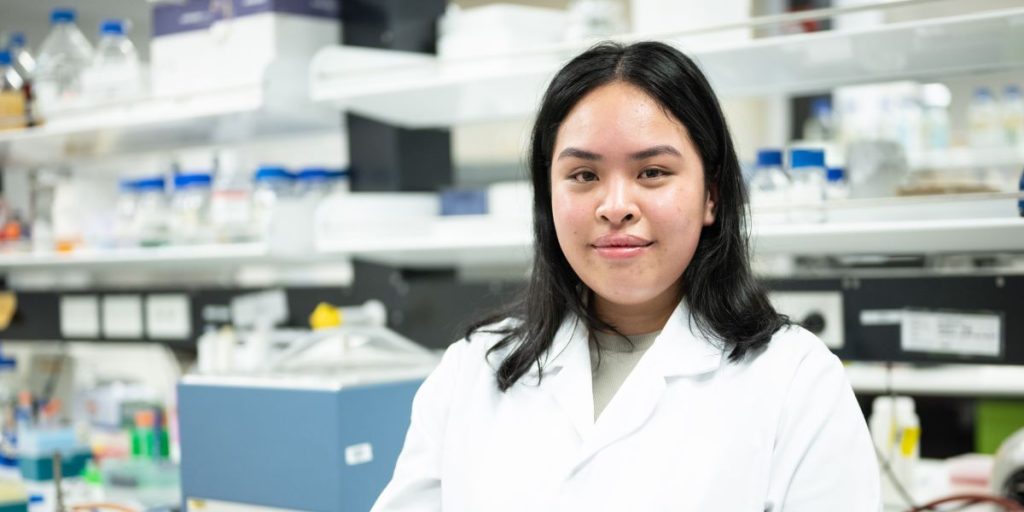
Sonesavanh Larnkham, a PhD candidate in the Pitman Lab Group at Te Herenga Waka Victoria University of Wellington, was awarded the Ovarian Cancer Foundation New Zealand’s inaugural International Travel Grant in 2024. This grant enabled Sonesavanh to visit a world-renowned ovarian cancer research facility at the University of Edinburgh, Scotland to learn from reputable ovarian cancer researchers Dr Charlie Gourley and Dr Robb Hollis and bring her experiences back to New Zealand.
Sonesavanh has recently returned from her trip and shares some of her experiences.
Can you tell us a bit about your work?
I am a PhD candidate supervised by Prof Janet Pitman and Dr Sarah Sczelecki. I’m part of a newly established research programme at the University of Wellington that is focused on improving early ovarian cancer diagnosis.
Our group has previously identified some genetic molecules, called micro-RNAs, that may be released into the bloodstream by ovarian cancer cells very early in disease development. My research involves validating these micro-RNAs as biomarker candidates for early epithelial ovarian cancer. The first step is to check if these micro-RNAs can be found in the blood samples of human ovarian cancer patients, which were kindly donated to the Wellington Gynaecological BioBank.
Why did you choose to visit the University of Edinburgh lab?
I had the option of visiting a number of renowned ovarian cancer labs, and while each of their projects were exciting, I based my decision on what would be the most beneficial for my research. It just so happened that Dr Robb Hollis’ lab offered to teach me the exact lab techniques and provide the knowledge needed to enhance my research, which was incredible luck.
What did you learn while there?
I got hands-on experience with analysing genomic sequencing data and identifying genetic mutations involved in low-grade serous ovarian cancer development. I also had the chance to shadow in the lab and observe different types of tissue culturing techniques.
This was extremely beneficial because, while our group has experience with sequencing data analysis and tissue culturing, our protocols are not yet fully optimised. Learning from Dr. Hollis and the team at the University of Edinburgh gave me valuable insights into how they carry out these techniques. My next step is to apply what I’ve learned, adapting these skills and methods to suit our group’s ovarian cancer research. We hope this will help improve our processes and make a real difference in our work.
What did a typical day look like in the lab?
Most days would involve a short walk to Western General Hospital, where I would work through analysing the sequencing data and meet with Dr Hollis to ask questions. Days in the lab involved shadowing researchers in the Gourley Group, observing the techniques they use to carry out their research and trying to absorb as much information as possible by asking millions of questions.
What was the highlight of the research trip?
Although the location was a highlight in itself, the true highlight was meeting people passionate about their work. It was amazing to see the number of people who were invested in the advancement of ovarian cancer research and the improvement of ovarian cancer treatment.
What are your hopes for the future of ovarian cancer research?
This experience emphasised the importance of collaboration and communication in the scientific community, which is crucial to gleaning new methods to use in the lab, overcoming roadblocks, and ensuring that research remains creative and new. Knowledge sharing is incredibly crucial for our community to move forward and ensure that ovarian cancer is improved in all aspects, from detection to treatment and survival.
What would you like to say to the supporters of OCFNZ who made your grant possible?
Thank you so much for the opportunity you have given me to broaden my horizons. The knowledge I have gained and the valuable connections I have made while being in the UK would not have been possible without this grant and I am very grateful to have received it.
If you would like to help fund transformational research, donate today!